How to Start Journaling: A Gentle Beginner's Guide
To start journaling, pick one place to write, choose a fixed moment in your day, and write for two minutes about what actually happened and how it felt. Keep the first entries short. One honest line counts. Repeat a few times a week rather than aiming for daily, and let the length grow on its own.
Most people who look up how to start journaling are not starting from zero. They already have a notebook somewhere, maybe two, with four entries at the front and blank pages after that. This guide is written for that reader: what the smallest real entry looks like, how to pick a format you will actually reach for, and what to do on the day you notice you stopped.
What journaling actually is, and what it is not
Before working out how to start a journal, it helps to know what one is. Journaling is taking something that currently only exists inside you and putting it somewhere outside you. That is the whole mechanism, and the page does not have to be good or finished.
It is written for you. There is no reader on the other side, no grade, and no version of you in the future who will judge the spelling. That single fact removes most of the pressure people bring to the first page.
You also never have to reread it. Many people find the useful part happens while the words are coming out, not later. If you never open the notebook again, the writing still did its job.
It helps to be clear about what journaling is not:
- Not an essay. No opening line, no argument, no conclusion. Fragments are fine.
- Not a performance. Nobody is watching, so there is nothing to make interesting.
- Not a record you owe anyone. A gap in the pages is not a debt. It is just a gap.
People have written about their feelings for a very long time, and researchers have studied the practice for decades. The honest summary is that the results depend on the person and the situation, so it is fairer to say many people find it helps them think more clearly than to promise it will. If you want a calm outside view of the same idea, The Guardian published a short overview of what journaling is for.
The smallest entry that still counts
Almost every beginner guide says start small. Very few of them say how small is allowed. So here is the floor, written out in full, so you can see the actual output rather than the instruction.
The ten second entry: a mood word and one influence
Pick the closest word for how you feel, then add the one thing that shaped it. That is the entire entry.
Tired. Long meeting that went nowhere.
This is a real entry. It is not a failed attempt at a longer one, and it is not a placeholder you owe more words to later. On a day when writing feels like too much, five words are the difference between a practice that survives and one that quietly ends. If you want to try that size right now, the mood tracker is a free browser tool that does exactly this: choose a mood, add a little context, done.
The two minute entry: three lines
Three lines, in this order: what happened, how it landed, what you want to remember. Set a timer if it helps, and stop when it goes off.
Went to the dentist, then walked home the long way.
Felt lighter than I expected for a Tuesday.
Remember that the long way is worth the extra fifteen minutes.
Two minutes is enough to notice something you would otherwise have walked past. It is also short enough that you will not start negotiating with yourself about whether you have time.
The ten minute entry: one moment, left messy
Pick a single moment from the day and follow it. Do not summarise the whole day. Let the sentences run on, contradict each other, and stop halfway.
The thing that keeps coming back is how quiet the room went after I said it. Not angry quiet. More like everyone was waiting for someone else to speak first, and I was the one who had spoken, so it could not be me. I do not know if I was right. I think I was right about the facts and wrong about the timing, or maybe I only think that because the quiet was uncomfortable and I want a reason for it.
That entry is deliberately unpolished. Tidying it up as you go is what turns a journal back into homework, which is the fastest way to stop.
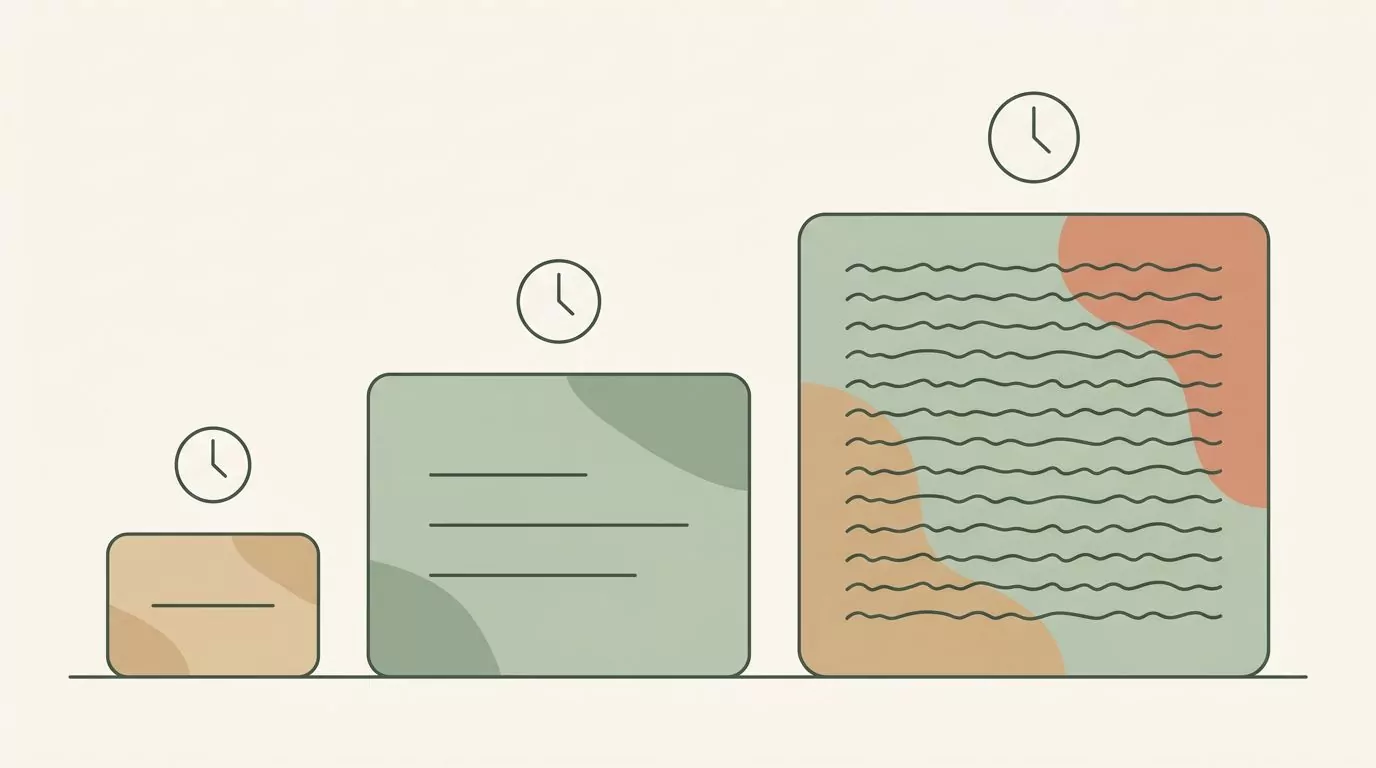
Three sizes, one rule: whichever one you can do today is the correct one.
Choose a format you will actually reach for
Most format advice is organised around what looks appealing. That is the wrong axis for a beginner. The useful question is where each format tends to stall, because that is what will actually end your practice.
| Format | Suits you if | Where it usually stalls | First thing to try |
|---|---|---|---|
| Paper notebook | You think better with a pen and want a screen free moment | The notebook is in the wrong room, or the blank page feels too formal to spoil | Leave it open on the surface you already use every evening |
| Notes app on your phone | You want to write in a queue, on a bus, or in bed | It lives next to every notification, so you open it and get pulled elsewhere | Make one pinned note and write to the top of it |
| Voice memo or dictation | Talking is easier for you than typing, or your hands are busy | You end up with recordings or transcripts you never open again | Keep each memo under two minutes and give it a one word name |
| Structured check-in | You want the lowest possible friction and a repeatable shape | The structure holds less nuance than a hard day sometimes needs | Use the optional note field only when you have something extra to say |
| Printable sheet on the wall or desk | You forget anything you cannot see, and you like marking things by hand | It is visible to everyone in the room, which limits what you will write | Use marks and short words, and keep the detail somewhere private |
Be honest with yourself about the tradeoffs in both directions. Handwriting is slower and more tiring than typing, and that slowness is part of why it is harder to interrupt. Typing is fast and always with you, which is the same reason it sits one swipe away from everything else competing for your attention.
Voice captures more than you would ever write down, including tone and hesitation, but it leaves you with material you may never revisit. A structured check-in is the easiest to keep up because there is almost nothing to decide, and the cost of that ease is that it holds less nuance. A paper sheet on the wall is the easiest to remember and the least private, which matters a great deal in a shared home.
One more thing about paper: a notebook can be lost, soaked, or thrown out by mistake, and then it is gone. That is a genuine tradeoff to accept when you choose paper, not a problem to solve. If the wall sheet approach appeals to you, the printable mood tracker is a free browser tool that makes a sheet you can print and fill in by hand.
You are also allowed to change your mind in week three. Switching formats is not starting over.
A first two weeks that does not depend on willpower
A plan built on motivation works until the first tiring week. A plan built on something you already do every day survives it. So the first two weeks attach the writing to an existing anchor rather than to a time on the clock.
An anchor is a moment that already happens without you deciding: after you brush your teeth, once the laptop closes, while the kettle boils, when you sit down on the train. James Clear calls this pattern habit stacking, and the format is simply: after this thing I already do, I write.
Week one. Five entries in total, any length, each one attached to your anchor. That is it. A ten second entry counts as one of the five.
Week two. The same five entries, plus one line of context on each: what was going on around the feeling. Who was there, what had just finished, how much sleep you had.
The whole plan as a checklist:
- Pick one anchor moment that already happens daily.
- Pick one place to write and leave it where the anchor happens.
- Week one: five entries, any length.
- Week two: five entries, each with one line of context.
- Missed days are expected. Two missed days still leaves room for five entries.
- At the end of week two, decide nothing. Just carry on or adjust the anchor.
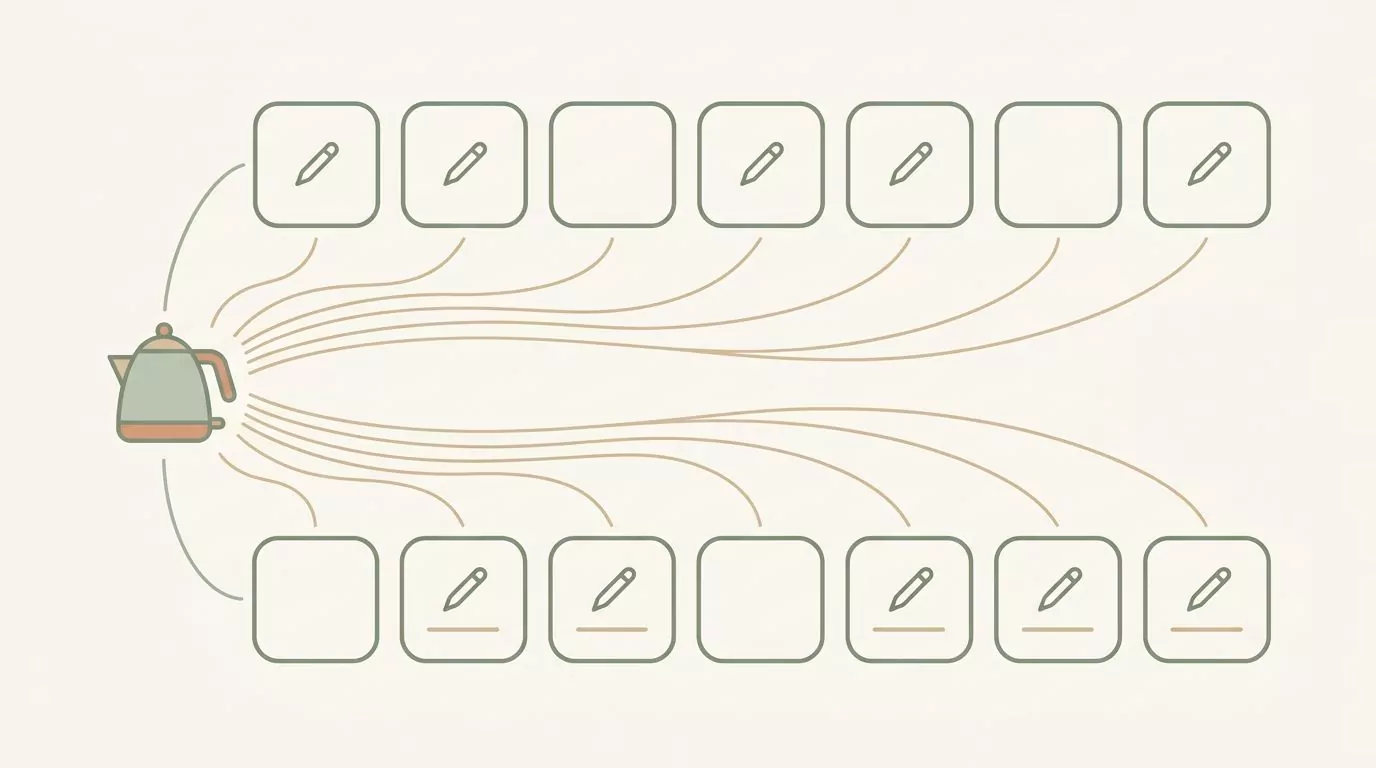
Five entries across seven days is deliberate. It builds a gap into the plan so that missing a day is a normal event rather than a failure, and you never have to decide whether the practice is over.
This is also why a daily streak target is a bad idea here. Plenty of advice on how to journal daily treats an unbroken run as the goal, and a daily journaling habit does sound tidy. A streak turns the journal into a scoreboard, though, and a scoreboard has a losing state. The first missed day then reads as the end of the run rather than an ordinary Tuesday, and that is the day most journals actually die.
What to write when nothing comes
Wondering what to write in a journal is rarely a lack of material. It is that nothing feels important enough to be worth writing down. A question fixes that, because answering is much easier than choosing.
Here are a handful of journal prompts for beginners, grouped by the moment you are in.
At the end of an ordinary day:
- What is the one thing from today I would tell someone about?
- What took more out of me than I expected?
- What was the best ten minutes of the day, and what was I doing?
After something hard:
- What actually happened, in order, with no interpretation?
- What was I most afraid would happen next?
- If a friend described this to me, what would I say back?
When you feel flat and cannot name why:
- What has my body been doing today: tired, restless, tense, heavy?
- What have I been avoiding thinking about?
- What is one small thing that would make tomorrow slightly easier?
Nine questions will carry you through the first couple of weeks. After that the need becomes ongoing rather than occasional, and a fixed list starts to feel stale. That is what the journal prompt generator is for: a fresh question whenever the page is blank, free in the browser, with nothing to install and no account to make. Open it, take the question, close the tab.
Six reasons beginners stop, and what to do about each
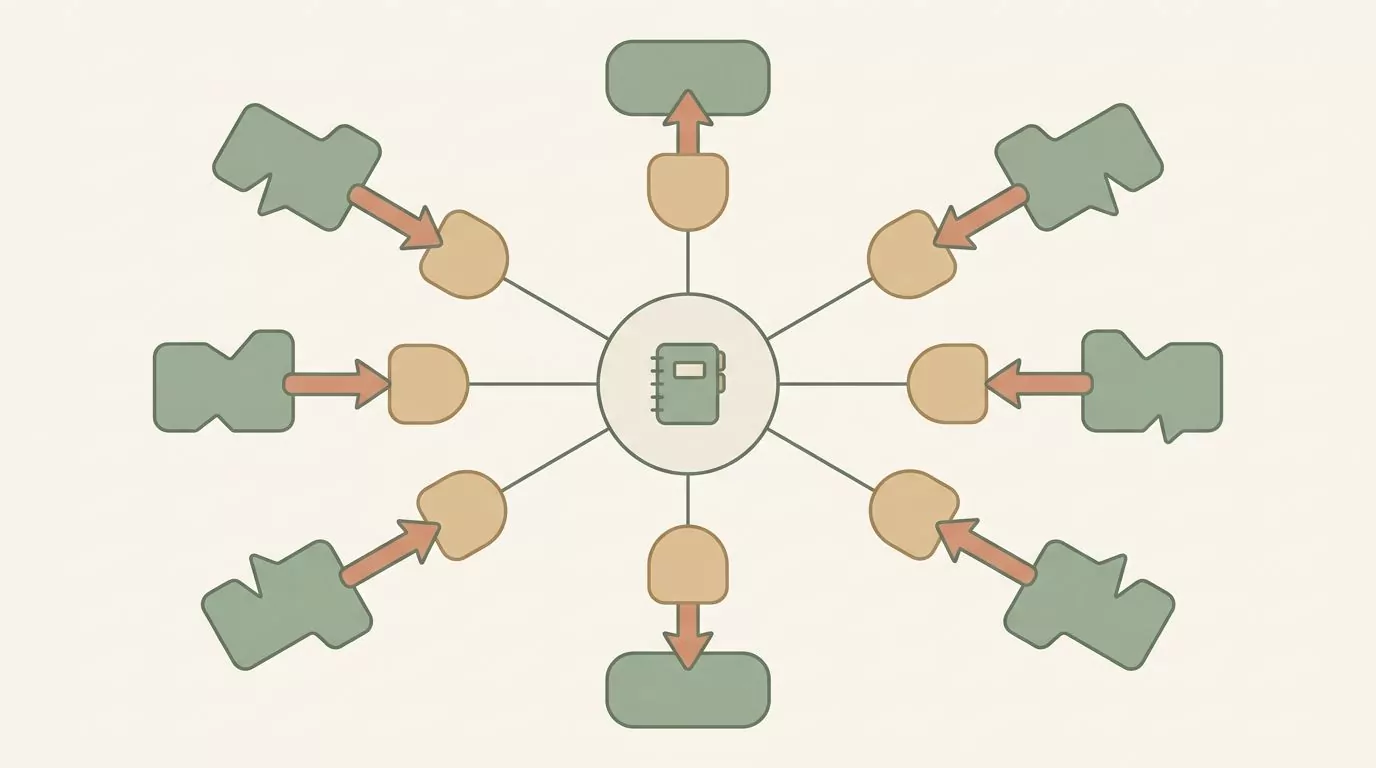
Journals rarely end because someone decided to quit. Journaling for beginners tends to end for one of a small number of ordinary reasons instead, and each one has a specific fix.
You keep forgetting
Forgetting is almost never a memory problem. It is that the writing is attached to a time of day rather than to an event, and times of day slide.
Attach it to something that already happens: after the last dish goes in the rack, once you plug in your phone at night, while the kettle boils. Then move the journal physically to where that thing happens. Most forgetting is solved by geography, not discipline.
It feels like homework
When journaling starts to feel like a task, the instinct is to move it to a better time. That rarely works, because the problem is size and not scheduling.
Shrink the entry instead. Go back to the ten second version for a week and let it be almost nothing. A practice you resent at ten minutes is often perfectly fine at ten seconds.
The blank page freezes you
An empty page asks you to choose a subject, and choosing is the hardest part. Remove the choice.
Start with a list rather than a paragraph: three things that happened, in any order, no sentences required. Or answer a question instead of facing empty space. Pulling one question from the journal prompt generator takes a couple of seconds and turns a blank page into a form to fill in.
You are worried someone will read it
This one is real and it deserves a real answer rather than a reassurance. If you are writing carefully because someone might open the notebook, you are not really journaling, you are drafting.
Decide where the journal physically lives, and decide it before you write anything you would not want read. The privacy section below walks through the practical version of this for both paper and phones.
You keep editing yourself
Rereading the last sentence and fixing it is a habit carried over from writing that other people see. Here it slows you down and pulls you out of the thought.
Write badly on purpose. Leave the typo, keep the repetition, let the sentence trail off. Grammar and word choice are not the point, and the version with the mistakes in it is usually the more honest one.
It stirred something up and you closed the notebook
Sometimes writing brings up more than you expected, and the notebook stays shut for a month afterwards. That is a common experience and not a sign you did it wrong.
Two things help. Set a timer before you begin, so the writing has a clear end rather than running as long as the feeling does. And give yourself permission to close the journal and leave the difficult thing on the page for now; you do not have to finish a thought the day you start it. If something keeps feeling heavy over a longer stretch, talking with a professional is a reasonable next step.
How to start journaling again after you stop
Nearly every guide is written for day one. Almost none is written for day nine, after three missed days, when the notebook has become slightly awkward to open. That day is when most journals actually end, so it is worth having a plan for it.
The restart move is short and slightly counterintuitive.
- Do not backfill. Reconstructing the days you missed turns the restart into a chore roughly four times the size of a normal entry, and you will not do it.
- Do not apologise to your journal. An entry that opens with a paragraph about how bad you have been at this is an entry about the journal, not about you.
- Do not reread the old entries first. Rereading before writing is how a restart becomes an evaluation of the last attempt, and evaluations are discouraging.
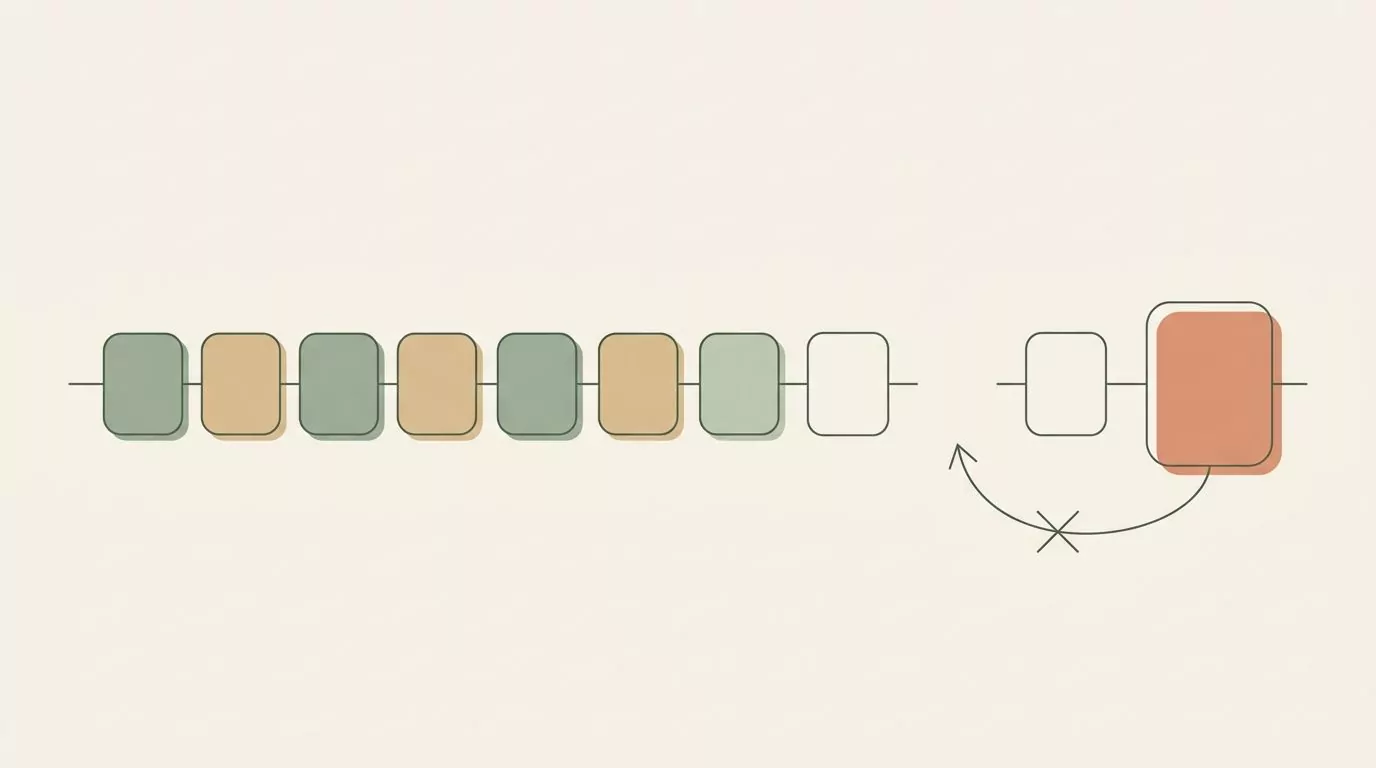
Instead, write today's entry as if today were the start. Same anchor, same smallest acceptable size, no ceremony. If the gap feels like it needs acknowledging, one line does it: Back after a few weeks off. No explanation required, because there is nobody to explain it to.
It also helps to expect this in advance. A journal that runs for two weeks, stops for a month, and restarts is not a failed journal. It is what a journal usually looks like across a year, and the restart is a normal part of the practice rather than a repair to it.
Keeping a journal private
The privacy question comes up in almost every beginner guide and gets left half answered. It is worth answering plainly, without any drama, because the practical version is simpler than it sounds.
Paper is private only if the place it lives is private. A notebook on a shelf in a shared living room is readable by anyone in the house, and knowing that will quietly shape what you write. Choose the location first, then write freely, rather than writing carefully because you have not chosen.
For anything digital, the usual leak is not a stranger breaking in. It is a shared computer, a shared login, or a phone with no passcode that gets handed around. Those are the cases worth thinking about, and they are all solved by ordinary things: your own account, a lock screen, and not writing into a document that lives in a shared family folder.
The two practical questions for a digital journal are whether it needs an account at all, and whether the words leave the device. Fewer copies in fewer places is the whole idea.
Mood Check-In is being built local first for iPhone, with journal content kept in app storage on the device, and no Mood Check-In account is required to write or look back. The iPhone app is coming soon; the browser tools linked in this article work today.
Finding a rhythm you can keep
Consistency matters more than daily. Someone writing three times a week for a year has a far richer journal than someone who wrote every day for eleven days and stopped.
Your frequency will also move around, and that is normal. Busy stretches produce short entries or none. Unsettled stretches often produce more. Neither is a verdict on how well you are doing this.
A workable rhythm usually has three parts: an anchor that survives a bad week, a smallest entry you can always manage, and no target you can fail. If a week goes by with nothing in it, the next entry is simply the next entry.
Later on, once there are enough entries to look back across, you may start noticing things you did not notice day by day. That arrives on its own and does not need to be chased, so let it happen in its own time rather than reading each entry for meaning.
If you would like a small place to begin before the notebook arrives, the free browser tools linked above need no download and no account, and the ten second version of an entry is a perfectly good first one.
Frequently Asked Questions
How do I start journaling if I have never done it before?
Pick one place to write and one moment that already happens every day, then write two lines at that moment. Do it five times over the next week, at any length. Skip the questions about which method is best and which notebook to buy, because those decisions are much easier to make after a week of entries than before.
What should I write in my first journal entry?
Write what actually happened today and how it landed, in that order. First journal entry ideas do not need to be meaningful: a description of an ordinary afternoon is a better start than a statement of intent about journaling. If you want a question instead of a blank page, ask yourself what took more out of you today than you expected.
How long should a journal entry be?
Long enough to say one true thing. A mood word and one influence is a complete entry, and so is a page. The useful habit is having a smallest version you can always manage on a tired day, so the practice does not depend on having ten spare minutes and the energy to use them.
Is it better to journal on paper or on your phone?
Neither is better in general, so choose by where you will stall. Paper is slower and harder to interrupt, and it depends on the notebook being in the room with you. A phone is always with you and always one swipe from a notification. Pick the failure mode you can live with and change your mind later if you need to.
How often should you journal?
A few times a week is a realistic starting rhythm, and it beats a daily target you will miss. Five entries across seven days builds in room for the days that get away from you. Once writing feels easy rather than owed, the frequency tends to settle by itself, and it is fine for it to move up and down through the year.
What do I do if I miss a few days?
Write today's entry and leave the gap alone. Do not backfill the missed days, do not open with an apology, and do not reread the old entries before you write. If the gap feels like it needs a mention, one short line naming it is plenty. Gaps are a normal feature of a long running journal rather than evidence that it failed.
Is it normal to feel embarrassed writing in a journal?
Yes, and it usually fades within a few entries. The embarrassment comes from an imagined reader, which is a habit carried over from writing that other people see. Deciding where the journal lives helps, because much of the self consciousness is really uncertainty about who might open it. Writing badly on purpose helps with the rest.